What's a Muleskinner, anyway?

My name is Deke Dickerson. I'm a full-time musician, with lots of interests. One of those interests is writing. I write for guitar magazines such as Guitar Player, Fretboard Journal, and Vintage Guitar. I also write music articles, liner notes, and books that accompany box sets.

Once, a long time ago, I thought it was weird to have your own web site. Then, I thought that myspace and Facebook were immature (turns out I was right about that one, but I'm on them anyway). When I heard the word "blog," I decried I would never have one. And yet, here I am. Enjoy...

Saturday, May 14, 2011

JOHNNY MEEKS’ FORGOTTEN TRIPLE-NECK GUITAR


A GUITAR MYSTERY SOLVED—Gene Vincent’s legendary guitarist Johnny Meeks and his triple-neck solidbody electric guitar


“Why, you’re the first to ever ask me about that damn triple-neck guitar,” said the gentle South Carolina accent on the other end of the phone.

The voice belonged to Johnny Meeks, a guitar player whose name is instantly recognizable to fans of legendary rockabilly star Gene Vincent.  Johnny Meeks was Vincent’s second guitar player--brought to the Blue Caps band in 1957 after their first guitarist, the also-legendary Cliff Gallup, quit due to the rigors of touring.  

Cliff Gallup brought a country-jazz sensibility to Vincent’s music, but Johnny Meeks brought a tough rock and roll twang that gave life to such classics as “Lotta Lovin’,” “Dance To The Bop,” “Baby Blue,” and many more.  Despite the fact that Johnny Meeks’ tenure with Gene Vincent’s band lasted less than two years, his guitar approach gave Gene Vincent a solid second half of his original career, and Meeks’ trebly tone set the stage for instrumental and surf music that came in the following years.

Below: The 1950's in Technicolor: Johnny Meeks, in the back center, behind Gene Vincent, foreground.

Those who enjoy the science of “Guitar Geekery” know that Johnny was most famous for playing a blonde 1957 Fender Stratocaster (dubbed the “Mary Kaye Strat” by collectors from a publicity picture showing the famous female jazz player holding a similarly appointed Stratocaster).  The truth was that Mary Kaye held the guitar in the promotional photograph for five minutes and then went back to playing her D’Angelico archtop. 

Johnny Meeks, on the other hand, took his blonde Strat on the road, hitting gymnasiums in Milwaukee and clubs in Dallas and wherever else you can think of, shows sandwiched in between trips to the Capitol Tower in Hollywood for recording sessions.  In retrospect, a more accurate name for the blonde Stratocasters made in 1957 and 1958 would be the “Johnny Meeks Strat.”

Below: Johnny Meeks (left) and the Blue Caps record at the Capitol Tower, Hollywood.  Note entire band is plugged into one amplifier!

To see these two-dimensional characters come to life, see Johnny Meeks wail on his blonde Strat here, from the 1957 movie "Hot Rod Gang."

True scholars of Johnny Meeks’ tenure with Gene Vincent also know that he briefly played a Gretsch 6120 before getting the Strat.  This Gretsch can be seen on Gene’s Ed Sullivan Show appearance here.  It’s interesting to note that Johnny played on the treble pickup on the Gretsch and got some pretty impressive Fender-like tones out of the 6120.  It is fair to say a great deal of the magic came from the man’s hands.

Below, a picture of Gene Vincent and the Blue Caps recording at the Capitol Tower, Hollywood, California.  Johnny Meeks is seen on the right playing a Gretsch 6120.

What piqued this Guitar Geek’s interest, however, were two photos circulating on the Internet showing Johnny Meeks holding a black and white triple-necked electric guitar.  No one seemed to know exactly what it was.  Some ventured a guess that it was made by Doc Kauffmann, the California-via-Kansas inventor responsible for the Kauffmann hand vibrato, and the first mass-produced guitars that Leo Fender had a hand in (1940’s “Vibro” and “K&F” guitars were Doc and Leo-produced instruments).  Doc Kauffmann also made a series of “Kremo-Kustom” guitars, which looked quite similar to the Johnny Meeks triple-neck guitar.  Doc made Kremo-Kustom double-necks and triple-necks, and used a black and white color scheme.  My first thought was that Meeks' triple-neck almost certainly had to be a Doc Kauffmann Kremo-Kustom instrument.

Below: A Doc Kauffmann Kremo-Kustom triple-neck guitar.

Johnny Meeks is still with us.  He is not an easy guy to find, but not because of stardom or any ill will towards his fans.  The truth is that he lives in a small town in South Carolina, doesn’t have a computer, doesn’t have a cell phone, and he likes it that way.  Meeks spent years in Los Angeles hammering away at the clubs, doing stints in various touring bands (Meeks played with The Champs of “Tequila” fame, played in the house band at the Palomino Club, and toured for a while with Merle Haggard).  These days he’s back in South Carolina, semi-retired, and doing little gigs here and there to stay busy.

Hear Johnny’s cool instrumental “Red Eye” by The Champs here).  

Below: a photo of Johnny Meeks, right, with The Champs.

After getting his phone number from Blue Caps drummer Dickie Harrell, I gave Meeks a call and found him getting ready to go to a show at the local swap meet.  I told him how we’d played together a few times nearly twenty years previous, but he had no memory of the shows.

Below: A photo of Johnny Meeks, center, on stage with the Dave & Deke Combo at the Palomino Club, circa 1991-1992. The author is at left.

When the small talk subsided, I asked him about the triple-neck guitar.

“A boy in Greenville, South Carolina made that guitar.  His name was ‘Pee Wee’ Melton, and he could pick, boy he could pick.  He made that guitar for himself, and I asked him if he would sell it to me, and he did.

“It was right after that I got hired by Gene (Vincent).  A lot of people joked that Gene wanted the guitar, not me!  That might have been the case, I don’t know, but it was an attention-getting guitar, for sure.

“I used the guitar when I first went on the road with Gene.  Not long after that, Gene bought the guitar from me, and started using it himself.  Not to play, ‘cause Gene couldn’t really play, but he used it as a stage prop, and it got lots of attention.

“I had two stints with Gene, with about a month or two in between after I left the first time.  When I came back to play with him again, the guitar was gone.  I never did find out from Gene what happened to it.  It’s got to be out there somewhere, right?  I mean, you don’t just lose a triple-neck guitar!”

Below: A poor quality picture pulled from the internet, the only other known photo of Meeks with the tripleneck guitar.

Meeks recalls that the three necks included a standard 6-string guitar, a 4-string mandolin, and a 12-string that he tuned both to standard 12-string tuning and the “Stratosphere” tuning, where the paired strings were tuned in minor and major thirds, allowing for a “twin guitar” effect.

Not much is known about the maker, ‘Pee Wee’ Melton, but there is a brief bio on the ‘Find-A-Grave’ website.  Apparently Melton had a stint in Nashville as a session guitarist, and wrote such songs as “High Tech Redneck.”  See Pee Wee’s memorial page here.

Gene Vincent kept touring, kept playing, and kept making records, until he died of a bleeding ulcer in 1971 at the age of 36.  After Johnny Meeks left his band, he never regained the momentum his career had with “Be-Bop-A-Lula” and “Lotta Lovin’.”

Johnny Meeks, one of the last men standing from the wild days of the 1950’s, jokes about his 57 years of playing experience: “Around here, they say well, you played with Gene Vincent, you played with the Champs, you played with Merle Haggard…how come you can’t keep a job?”


Two faded snapshots, one man’s memory, and a forgotten guitar—these are all that remain of ‘Pee Wee’ Melton’s triple-neck instrument.  The mystery may be solved for the time being, but the guitar is still out there somewhere.  Only if the winding rivers known as Fate and Lady Luck intertwine will we ever know more.

Written by Deke Dickerson

Wednesday, May 11, 2011

LEFTY FRIZZELL--"He Died From Heartbreak"


LEFTY FRIZZELL—Liner notes to the Bear Family CD "STEPPIN' OUT"


Lefty Frizzell was the greatest honky-tonk singer of all time—if you ask the most educated and highly opinionated fans of country music, that is.  Blessed with a voice that came naturally to him—a voice that held so much soul and carried such infinite layers of emotional expression, that grown men were oft-moved to tears—Lefty was also cursed with bad habits and a downward career path that left him dead in 1975 at the tragically young age of 47.

This compilation of tracks, part of the ‘Gonna Shake This Shack’ series, seeks to compile all the up-tempo numbers—hillbilly boogie, rockabilly, borderline rock and roll and hard late 1950s country—for a package that will undoubtedly appeal to crowd of rockabilly fans and those seeking to have a lone Lefty Frizzell disc in their collection.

Let it be known, however, that a disc that contains only the uptempo Lefty Frizzell numbers is much like a painting that uses only two of the primary colors.  Lefty’s incredible depth of emotion lent itself best to plaintive ballads and waltzes, and although the uptempo numbers are also great, if you really want to experience the full breadth of Lefty’s talent this author urges you to seek out the most essential of Bear Family box sets, ‘Life’s Like Poetry.’ (BCD 15550)

William Orville ‘Lefty’ Frizzell was born March 31, 1928 in the oil and farm town of Corsicana, Texas, about 50 miles southeast of Dallas.  As a young child, his family moved to El Dorado, Arkansas, where they remained until Lefty was a teenager.  Although the family would always call him ‘Sonny,’ since he was the first boy in the family, the nickname ‘Lefty’ was acquired during a school fight with another boy.  The nickname—which came because Lefty led with his left hand in the fight—stuck with him throughout his life, even though Lefty played his guitar right-handed.

As a child, Lefty loved music and began playing guitar at a young age, even securing a spot on a children’s radio show on the local station KELD at the age of 12.  When the Frizzell family moved back to Texas, Lefty won a talent contest in Dallas, which bolstered the youngster to continue in music, which he did, alternating between working in the Texas oilfields and performing at honky-tonks on the weekends.

In 1945, Lefty wed Alice Harper, when both of them were 16 years old and too young to get married without parental permission.  Soon afterward their first child, Lois, was born, and in 1946 Lefty and his new family moved to New Mexico in search of a better life, first to Capitan and then to Roswell, a then-booming Army town close to the West Texas border.

Lefty pursued singing and writing songs in Roswell, while Alice worked at a downtown cafĂ©.  A local musician had a Wilcox-Gay disc recorder, and Lefty begged to get some of his songs recorded on the primitive device, such was his desire to become a professional singer. 

Times were tough and the family nearly starved to death, circumstances made worse by Lefty’s tendency to get in trouble with the law.  Eight days after the legendary Roswell ‘U.F.O.’ crash happened in Roswell in July 1947, Lefty was arrested and served six months in the Roswell jail for what he called “fightin’ and carryin’ on” in a later interview.  In reality, the charges were statutory rape, a married 19-year old man caught with a 14-year old girl.  The time Lefty spent in jail just about killed him, wondering if Alice would take their new baby Lois and leave.

Whether ‘U.F.O.’ crashes or captured alien beings played into the equation, Lefty wrote the first of many future hit songs in the Roswell jail in September 1947, I Love You A Thousand Ways.  The song was a plaintive apology to his wife Alice for his misdeeds.

Upon release in early 1948, Lefty and family moved back to Texas, where eventually he would set up a residency at the Ace of Clubs in Big Spring, a club gig that would last more than a year.  Lefty’s original songs were popular with the local crowds, and on many occasions people recommended that Lefty should try making records.

Eventually Lefty heard about a talent scout in Dallas by the name of Jim Beck, and he set out on the 300-mile trip from Big Spring to Dallas in April 1950, to audition for Beck, the pleasure of which cost Lefty and his band one hundred of their hard-earned dollars.

Dallas, Texas in the late 1940’s was quickly establishing itself as a country music hub.  There was a large ‘Opry’-type show there, the ‘Big ‘D’ Jamboree,’ which drew thousands each week to the Sportatorium in downtown Dallas.  The show was broadcast on the radio to most of the southern United States.

Jim Beck was a magnet for talent in the area, where he not only ran the only real professional recording studio in Dallas at the time, but also through his work as a talent scout and A&R man for such labels as Columbia, King, Bullet, and Imperial.

Columbia Records in particular drew a lot of talent from the Dallas area, signing hillbilly acts like Frankie Miller and Charlie Adams, and rockabilly acts like Sid King and the Five Strings, among others.  Included in that talent pool, and the greatest discovery for Beck and Columbia Records, was a fresh-faced kid named Lefty Frizzell.

While Beck was mildly interested in Frizzell’s ballads, it wasn’t until Lefty sang him a new song he had been working on, If You’ve Got The Money (I’ve Got The Time) that Beck’s ears really perked up.  There are many versions of the story, and fifty years later it is hard to separate the wheat from the chaff in deciphering these many accounts, but what counts is that by July 1950 Lefty was recording his first session at Jim Beck’s studio as a newly signed Columbia Recording artist.

This compilation begins with a track that makes buying this CD essential—an unreleased track from 1950 that didn’t make it on the original Bear Family box set due to licensing problems at the time.  Steppin’ Out is a wonderful slice of honky tonk—co-written by Hank Williams and Jimmy Fields—that is heard on compact disc for the first time here—a rare 45 reissue of the song was released in the 1980s, but is finally here on CD for the Lefty fanatics.

Lefty’s first few sessions in 1950 and 1951 resulted in several of the biggest hits of his career—If You’ve Got The Money (I’ve Got The Time), I Love You A Thousand Ways, My Baby’s Just Like Money, I Want To Be With You Always, Always Late (With Your Kisses), Mom And Dad’s Waltz, and Don’t Stay Away (Till Love Grows Cold).  These early successes would be the biggest hits Lefty would ever have (save for the #1 hit Saginaw, Michigan in 1964), and although he would have charted records sporadically even into the 1970s, these songs would be forever known as his greatest hits.

From these early sessions, with their primal musical backing (featuring the mysterious Madge Sutee, a piano-pounding female in the Del Wood tradition), we have included here the up-tempo numbers Shine, Shave, Shower (It’s Saturday), When Payday Comes Around, You Want Everything But Me, Give Me More, More (Of Your Kisses), If You Can Spare The Time (I Won’t Miss The Money), I Won’t Be Good For Nothin’, and I’m An Old, Old Man (Tryin’ To Live While I Can).  None of these were big hits, but all of these are excellent examples of 1950s Texas honky-tonk.  To modern ears the barrelhouse piano and loose arrangements may make the Jim Beck recordings of this era sound quite primitive and dated, but this is exactly the way bands of this era sounded in the dusty Texas icehouses and taverns.

Lefty’s first flush of success brought large sums of money, even after Jim Beck’s “songwriting” cut and Jim Bulleit’s “publishing” cut (sadly, this was a defining theme in Lefty’s career—he trusted the people around him, all of whom cut themselves in to large chunks of his money, usually for some easy money up front as an advance).  Lefty, like Hank Williams and Elvis Presley, was another poor country boy with no training on how to deal with success and the money that came with it. 


These early years brought Cadillacs, fancy Western Suits, a tour bus, an airplane, and all the accoutrements of hillbilly flash that a hot young star could want.  Soon Lefty had a flashy new Gibson SJ-200 guitar, the top of the line instrument that the Gibson company made.  To add icing to the cake, not long after buying the guitar he took it to Paul Bigsby in California to have a new custom neck put on, and a custom pick guard with Lefty’s name inlaid on it.  This guitar would be the iconic representation of Lefty’s image for many years to come, and though he sometimes toured with other guitars, Lefty kept the guitar until the day he died.  After Lefty died, it was displayed in the Country Music Hall Of Fame for decades (the instrument was finally sold last year, and the buyer was none other than Merle Haggard).

In 1951 Lefty was invited to be a cast member of the WSM ‘Grand Old Opry’ in Nashville, where he shared a dressing room and co-star billing with another bright light of the era—Hank Williams.  Though the two had jived between each other about who was the bigger star, there was more a friendly rivalry than anything else. 

In the liner notes that Charles Wolfe wrote for the ‘Life’s Like Poetry’ box set, Disc Jockey Hugh Cherry remembered a conversation between Lefty and Hank that took place in 1951 at Eddie Dubois’ Key Club in Printers Alley in Nashville:  “We (Hugh and Hank) were sitting there and Lefty came in by himself, a little greased, and sat down with us.  Hank decided to feign displeasure with Lefty, and he started out by saying, ‘Here boy, why don’t you just stay down in Texas, this is my territory up here.’  This was about the time that Lefty had all the chart songs, and Lefty got that big smile on his face, and said, ‘Hank, the whole damn country is the back yard of both of us; can’t you realize there’s enough room for all of us?’  Hank kind of smiled and said, ‘Well, I was just kidding.  Actually, it’s good to have a little competition.  Makes me realize I got to work harder than ever.  And boy, you’re the best competition I ever had.’  That pleased Frizzell very much, because there really was a great admiration which existed between the two.”


Lefty’s tenure on the Opry was short-lived.  Most people in the business of Country Music know that Opry membership is a double-edged sword—while the exposure and popularity of the show is unparalleled, the money that the Opry pays its performers is often a mere fraction of what a ‘hot’ artist can make on a Saturday night.  As a result, Lefty’s manager of the time (Jack Starnes, one half of Starday Records in Texas) began booking Lefty on a hectic string of performances all across the United States, forfeiting Opry membership.  In retrospect, it may have been a prudent financial decision at the time, but ultimately hurt Lefty’s popularity in the long run.

It didn’t take long—barely a year or two—before the flush of success and fame and money became too much for Lefty to handle.  He was always a drinker, but now the temptations of roaring all night were often too strong to resist.  In the same way that people today love to tell George ‘No-Show’ Jones stories, in the early 1950s ‘Lefty Frizzell stories’ were a commonplace discussion amongst country music fans.  It was a reputation, albeit well deserved, that Lefty would carry until his death.

A common practice in the early days of country music involved a star hiring a ‘front man,’ or another singer and M.C. who would warm up the audience before the star came out.  Lefty was no exception, but Lefty’s front men were expected not only to warm up the audience, but also to handle the often too-drunk-to-perform and belligerent ‘star’ backstage.  Freddie Hart, who later became a big star in his own right, began his career as one of Lefty’s front men.  Hart has nothing but positive things to say about his former boss, and credits Lefty with discovering him and getting him his first recording contract—but tells of many nights where he would have to perform the entire show to a crowd of disappointed and angry patrons, with Lefty backstage unable to perform.

The years 1951 through 1955 were turbulent ones for Lefty.  The management relationship with Jack Starnes soured, resulting in a lawsuit against Lefty, settled out of court, that took away most of the royalties of the earlier recordings, as well as his excellent touring band.  Lefty soon found management and musicians through J.D. Miller in Crowley, Louisiana, including the excellent front man Lou Millet, but the relationship was again short-lived.  By 1953 Lefty and his family had relocated to California, where Lefty found a new manager—Steve Stebbins— and joined the cast of the ‘Town Hall Party’ television show.

The biggest problem amongst all this turmoil in Lefty’s life through these years was the lack of hits.  The new sensation that had four songs in the top ten in 1951 barely dented the charts in the mid-1950s.  Many great performances were released during this time, but none of them had the chart magic to click with the buying public.  You Can Count On Me and Run ‘Em Off, from 1953, and Mama, from 1954, are found on this collection, superb tunes but ignored at the time of their release.

If one had to mark a place in Lefty’s career that delineated the early years from the later years, it would have to be the year 1956 and the change of recording from Dallas to Nashville.  Lefty had continued to record in Dallas at Jim Beck’s studio, mostly at the behest of Columbia A&R man Don Law.  What few people know today is that Law was preparing to make Dallas the center of Columbia’s country music recording, and Decca Records’ Paul Cohen was about to do the same, decisions that would have placed Dallas as the “Country Music Capital of the world,” instead of Nashville.

What transpired is a little-known event but one that shook the landscape of country music recording—Jim Beck died in May 1956 after cleaning his tape recorders with carbon tetrachloride, an effective but deadly solution that requires adequate ventilation and short exposure times.  Beck ignored these dangers and inhaled too much of the cleaning solution and died a week later, taking with him the future of country music recording in Dallas, Texas.


With Jim Beck out of the picture, Lefty began recording in Nashville at Owen Bradley’s recording studio just a few weeks after Beck’s death.  What that meant in the big picture was a radical change in the sound of Lefty’s records, not only with a different, more ‘polished’ recording fidelity, but also with a completely different set of musicians.  The end result, taken as a whole in Lefty’s oeuvre, is an obvious difference in the sound of the earlier Dallas recordings and the post-1956 Nashville recordings.

Just Can’t Live That Fast Anymore, recorded at the first session in Nashville, was one of Lefty’s best up-tempo records of the 1950s.  This first session featured three of Hank Williams’ former band members—Sammy Pruett on guitar, Don Helms on steel guitar, and Jerry Rivers on fiddle—but if there was attempt to unite Lefty with Hank’s band on his return to Nashville, it was short-lived.  Over the next fifteen years, Lefty would record mostly with the Nashville ‘A-Team’ session musicians, specifically with Grady Martin on lead guitar acting as de facto arranger and producer on most of his sessions.

Lefty was just too country to ever really record rock and roll or rockabilly, but like most of his contemporaries, Lefty saw Elvis Presley taking away a lot of the country music revenue, and Lefty flirted with the ‘Big Beat’ like nearly every other country artist of the day.  While he would probably write off these records as novelties, and certainly not his best work, the fact remains that many of the tunes Lefty recorded from 1956-1959 have become favorites among the rockabilly cult.

Cuts included on this CD such as From An Angel To A Devil, No One To Talk To (But The Blues), Time Out For The Blues, My Bucket’s Got A Hole In It, Cigarettes and Coffee Blues, and You’re Humbugging Me exhibit all the qualities of great rockabilly, and with the band featuring Grady Martin on lead guitar, Bob Moore or Roy ‘Junior’ Huskey on bass, and Buddy Harman on drums, these records have the sound and feel of other records recorded at Bradley’s studio from around the same time.
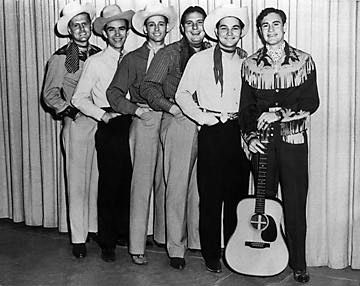
A California session in March 1957 found Lefty recording with the ‘Town Hall Party’ band (featuring Joe Maphis on guitar), singing a duet with Johnny Bond on Sick, Sober, And Sorry, also included here.  There were a pair of California sessions and a Nashville session in 1958 that had Lefty reprising his earlier hits with a more polished late-1950s sound (all for an updated ‘Greatest Hits’-type package released as ‘The One And Only Lefty Frizzell’).  The versions of If You’ve Got The Money (I’ve Got The Time) and Always Late (With Your Kisses) found here date from these sessions, by no means Lefty’s finest hour but an interesting mix of 1950s pop-rock and country-western.

Around this same time in the mid-to-late-1950s, Lefty joined many of his contemporaries in the country music world by recording radio shows for the popular Armed Forces program ‘Country Music Time,’ broadcast by recorded transcriptions to soldiers across the USA and the world.  These radio shows are a fascinating glimpse into what country music shows sounded like at that time, because the vast majority of these ‘Country Music Time’ transcriptions were recorded live in the studio with the singer and his or her touring band.

The Lefty Frizzell transcriptions feature great performances that are often quite different from his recordings (for instance, Lefty’s live version of Cigarettes And Coffee Blues heard here is much truer to Marty Robbins’ original demo version that Marty pitched to Lefty than the rockabilly-powered version released as a Columbia single), as well as instrumentals and performances by guest artists (Freddie Hart is included on several of these transcriptions, and here we have included Lefty’s brother David singing the popular Carl Mann hit Mona Lisa).  From these transcriptions we have also included Desert Blues, Somebody’s Pushin’, Sunday Down In Tennessee, and You Win Again.

The last five tracks on this compilation date from the late 1950s and early 1960s and are more stone country than anything else, but they have that certain something that we feel will appeal to fans of the ‘Gonna Shake This Shack’ series.  Farther Than My Eyes Can See is a great Freddie Hart composition, cut at the same session in July 1959 as My Blues Will Pass, both featuring the unmistakable sound of Grady Martin on guitar.  So What! Let It Rain dates from 1960, and Heaven’s Plan dates from 1961, both being the closest Lefty ever came to a pop-rock crossover sound.  The latest track on the CD is She’s Gone, Gone, Gone from 1965, a song which surprisingly has become a breakout hit in the last few years among the rockabilly and retro country crowd.

Although Lefty would make hundreds more recordings from 1960 until his death in 1975, the thirty-five tracks found on this CD best represent the hillbilly boogie and rockabilly side of Lefty Frizzell.

Lefty would ultimately have two of his biggest hits in 1959—The Long Black Veil—and 1964—Saginaw, Michigan, the latter being the biggest chart hit of his career.  There was another front man and duet partner—Abe Mulkey—who would continue to perform with Lefty until his death.  There would be thousands more shows, more short stops on the long way down, and a few more flirtations with the country music charts, before Lefty finally gave up the ghost and died July 19, 1975.  He was only 47 years old, but in photos taken before his death, he looks like an elderly man, aged beyond his years.

Lefty’s singing style has left a longer-lasting impression than any of his 1950s contemporaries, mostly through the influence of Merle Haggard, who has admittedly taken the Frizzell slurred-syllable singing style as a cornerstone of his entire career, influencing more modern stars such as Randy Travis in the process.

In an interview with the author for a recent box set, Merle Haggard had this to say about Lefty’s death:  “Lefty got his feelings hurt, and the thieves robbed him of his inspiration, and they robbed him of his money, too…and they took his songs.  He should have been able to say, ‘I’m Lefty Frizzell.’  He was only 47 years old, he should have been sittin’ in that place Eddy Arnold had.  But, because he was a poor boy, a little boy from Texas without any representation, man, they took him to the cleaners.  Everybody did.”

Merle continues: “Lefty was a bright guy, but he was a very forgiving nature, very pleasant person, and I think he held it all inside.  And I think it bothered him so much, that he had that stroke.  He became very weak, in the last days, I talked to a lot of people around him.  And he just kind of slowed down, and cuddled up and died, from heartbreak.  Alice, his wife wasn’t satisfied with him, the music world had turned their back on him, he got beat out of all the money, he had outgrown the glory, and he didn’t have no reason to be alive…he knew that he had peaked out.  And I think when you reach that point in your life, where you know that you’re not going to do anything else that will be worth a damn, I think you sort of start to shut down.  Somethin’ will get you…and he was a blood clot waitin’ to happen, you know.”


This collection seeks to squarely focus on the good times, the honky-tonk high-water mark—Lefty Frizzell’s glory period of the 1950s and early 1960s.  The boots still had a fine sheen to them, and the clothes were crisp and newly tailored.  Enjoy the styling of the finest singer country music has ever known—a man from Corsicana, Texas, by the name of Lefty Frizzell.

Deke Dickerson

Thanks to Merle Haggard

FARON YOUNG--Live Fast, Love Hard, Die Young


FARON YOUNG --liner notes to the Bear Family CD “GONNA SHAKE THIS SHACK TONIGHT”


       When Country Music Hall of Fame singer Faron Young was asked about the rockabilly and rock & roll sides he cut in the 1950s, his answer was simple: “I was not cut out to sing that kind of music,” he told David Booth, “but when you drop $400,000 a year, you’ll try anything you can.  I’d have tried to paint myself black!  When I hear any of that stuff today, I turn fourteen flips in the air, I hate it!” 
       What makes such a statement ironic is that while the teenage-themed pop-a-billy sides he waxed in the late 1950s were forced upon him and bear the authenticity of such, the fact remains that Faron Young’s hillbilly boogie songs of the early and mid 1950s were as influential to the new crop of rockabillies as anything else, with their braggadocio lyrical content and aggressive boogie-woogie guitar-based sound.
       Songs like Live Fast, Love Hard, Die Young, I’m Gonna Live Some Before I Die, and If You Ain’t Lovin (You Ain’t Livin’) preached a lifestyle that was immediately adapted by the first wave of rock and rollers as their own.  Almost as importantly, Faron Young lived the kind of life he sang about, a life that would define “rock star behavior”—women, pills, booze, and lewdness of the highest order—which would become a mainstay of the four-letter word called Rock.
       This disc encapsulates but a brief time in Faron Young’s long career, but is a perfect one to show how influential Faron was to the new music known as the Big Beat, and is the perfect compilation for those who prefer the uptempo hillbilly, rockabilly and rock & roll side of Faron Young.

Below: Faron and Patsy, in the good times.

For a better examination of Faron’s ten years on Capitol Records, check out the excellent Bear Family box set (BCD 15493) Faron Young—The Early Years 1952-1962, which takes you all the way from his early Hank Williams sound-alike recordings, to his lush countrypolitan hits of the early 1960s, and everything in between.  Faron also kept recording for Mercury well into the 1970s, recording such notable hits as Wine Me Up and It’s Four in the Morning.
One thing that can be said of Faron’s 30-plus-year recording career is that he always kept up with current trends in music—which goes a long way to explain the recordings on this compilation, which spans nearly every trend in country music from the early 50s until the early 60s.
       Faron was born on February 25, 1932 in Shreveport, Louisiana, a town that would weigh heavily on the ascent of his musical career.  While he seems to have been raised in a typical depression-era household, he also appears to have been a typical middle-class American child of the post-war boom in every other way.  He not only completed high school, but also attended college until the show business bug bit him.  Country music seemed unimportant to his early life, preferring the pop music of the day such as Patti Page to the rough and rowdy hillbilly music that would eventually become his bread and butter.
       What got Faron Young into music was his lifelong need for attention.  He began entering amateur contests at a young age, singing pop songs and picking coins off the stage for pay, but appears to have been steered into the country music world when a man offered him five dollars to sing Jambalaya, instead of the twenty-five cents he was used to receiving for a typical pop request.


       Faron’s quick rise to fame in the country music world can be explained quite simply—he was a good looking young man in the right place (Shreveport, home to the Louisiana Hayride) at the right time (the peak of Hank Williams popularity), with an unquenchable thirst to be somebody.  As a detective might characterize it, Faron had means, motive and opportunity—of which he took full advantage.
       As legend has it, Faron had a small bit of experience playing the clubs around Shreveport, but had great aspirations even from the start.  His first break came when he auditioned songs for local star Webb Pierce.  Rather than buying the compositions, Pierce instead liked Faron’s singing voice and began paying Faron to warm up his shows and sing for him when he got too drunk or tired (This is a time-honored tradition in the country music world.  The position is called “front man” and is as ubiquitous in the country music world as a rapper’s “posse” is in the realm of hip-hop).
       Faron stayed with Pierce for about a year as his front man, long enough for Pierce to get him on the Louisiana Hayride show, and to get Faron his first recording contract, with the tiny Pacemaker-Gotham label of Philadelphia (the same label that Pierce’s initial releases were on).
       The first release with Faron’s own vocals was oddly credited to Tillman Franks, who played bass for Pierce and Faron.  We’ve included both sides here, both great examples of primitive hillbilly boogie, Hi-Tone Poppa and Hot Rod Shotgun Boogie No. 2, which were originally released at Gotham 412.
       Faron’s three releases on the Pacemaker-Gotham label didn’t sell at all outside of the local area, but again luck seemed to be on Faron’s side.  Capitol Records A&R man Ken Nelson (a legendary figure responsible for signing the Louvin Brothers, Buck Owens, Merle Haggard, Gene Vincent and others to the label) heard a live broadcast by Pierce and Faron as he was driving to Dallas.  Knowing that Pierce was signed to Decca, but sensing that the young singer might be available, Nelson turned his car around and drove back to Shreveport, where he offered Faron a Capitol recording contract on the spot.  Faron Young would record with Capitol for the next ten years.
       Faron liked to say that he had a hit with his first record on Capitol, but the truth is that it took three singles before he had his first bona fide hit, Goin’ Steady.


       Goin’ Steady was much plagarism at it was creation.  Recorded just months before Hank Williams died, and hitting its peak on the charts as the nation mourned his passing, the record could have been an unreleased Hank performance, such was Faron’s vocal imitation.  As Faron himself admitted, “Everybody’s an imitator when they start, and believe me I had no style at all when I started.”
       The Hank Williams parallel was based on real-life experience, too.  Faron holds the dubious distinction of introducing Hank to Billie Jean Jones, on a trip to the Grand Ol’ Opry in the summer of 1952 (where Faron was invited to join the cast as a semi-regular guest).  Billie Jean came to Nashville as Faron’s date and wound up marrying Hank Williams.  Billie Jean would marry Johnny Horton after Hank’s death and became known in the country music world as “The Black Widow” after Horton’s tragic death in 1960.  Asked if he had any bitter feelings about losing Billie Jean to Hank, Faron would state “I sure am glad ol’ Hank took her away from me because she’d have cost me a damn million dollars by now.”
       Goin’ Steady was breaking on the charts just as Faron got inducted into the Army, in November of 1952.  He went from making $500 a night to making $87.50 a month, however, although it seemed like a career killer at first, eventually Faron discovered it was another great opportunity for him.
       With his status as a well-known singer, Faron was given the cushiest life a “soldier” could get.  With a fan who was a Third Army General, Faron was allowed to continue appearing on the Opry, he was able to play small clubs near his Army base (in Fort McPherson, Georgia), he could still record new sessions for Capitol, and perhaps best of all, he was given the special assignment of recording transcriptions that were sent out to 2000 radio stations a week.  It was great publicity he couldn’t buy as a civilian, but as a soldier he was getting more exposure than ever.  Then, as now, a singing soldier dressed in fatigues was a powerful image and the country music fans ate it up.
       Timed almost perfectly with his release from the Army, Faron’s next big hit was the one to define the rest of his 1950s style—If You Ain’t Lovin’ (You Ain’t Livin’).  Written by Bakersfield songsmith (and fellow Capitol recording artist) Tommy Collins, the mixture of hillbilly boogie musical backing, lyrics about honky-tonk wild living, and Faron’s plaintive vocals were a magical mixture.
       Faron would continue this trend with a series of fantastic sides, all of which are included here—Live Fast, Love Hard, Die Young, I’ve Got Five Dollars (And It’s Saturday Night), It’s A Great Life If You Don’t Weaken (And Who Wants To Be Strong), and I’m Gonna Live Some Before I Die, all of which were nearly identical in lyrical content and musical performance.  Faron was clearly mining a winning formula, with fantastic results.


       The strongest criticism that may be leveled of Faron Young’s musical career is that he was willing to do anything, follow any direction, to be successful in the music business.  When hillbilly boogie was the fashion, he cut great records like the ones mentioned above.  When pop music appeared to be the new trend, he made horrific records like The Shrine Of St. Cecilia, which thankfully bombed or we wouldn’t speak of Faron in such glowing terms today!
       All of which goes a long way to explain why Faron was dragged kicking and screaming into the world of rock & roll.  Ken Nelson, the A&R man for Capitol who had signed Faron, showed Faron how well singers like Elvis Presley and Capitol’s new star Gene Vincent were selling in comparison to the country roster.  Faron’s fortunes had been dwindling since rock & roll had reared its head, and in his words, he would rather sing rock & roll than be poor.
       Faron’s rockabilly sides, most notably Honey Stop! And I Can’t Dance, are records that while enjoyable, are easily dismissed.  The instrumental backing on these and his other forays into rockabilly and rock & roll are simply superb—the Nashville A-Team at their rocking best.  However, Faron’s vocals sound exactly like what they are—a country singer being forced to step into Presley territory and not liking it one bit.
       At least these sides can still be enjoyed for their musicianship and great sound quality (courtesy of producer Owen Bradley).  They are certainly not bad, especially compared with some of the real honest-to-goodness clunkers that Faron cut through the years, but you can just tell the man’s heart was not in it.
       By the late 1950s, Faron seemed to be back on track. Perhaps rekindled by the chart success of Ray Price, Faron began recording hard honky-tonk numbers like Alone With You and That’s the Way I Feel.  Such records kept an almost rockabilly-esque delivery, but which featured a return to the twin fiddles and steel guitar sound. 
       Much of the excellent material Faron recorded around this time came from the members of his road band, which included future superstars Roger Miller on drums and Johnny Paycheck (then known as Donny Young) on bass.
       Faron also brought along a host of new and inexperienced “front men,” many of whom would later become stars.  From the Wilburn Brothers to Jimmy & Johnny to Gordon Terry and others, Faron had a knack for picking out young, super talents, and many of these afore-mentioned stars got their first break touring as Faron’s front men. 
       Another one of Faron’s unknown discoveries was a young Texas songwriter by the name of Willie Nelson.  Willie was another knockabout who spent time touring with Faron, Ray Price, and others, all the while composing songs that he would pitch to those who would listen, and toiling in near obscurity as a writer for Pamper Music in Nashville.
       Faron was most certainly listening when he heard a new Willie composition from a Pamper Music demo, entitled Hello Walls.  His firm belief in the song (even as the studio musicians poked fun at it during the recording session, and as Willie tried to sell the song outright to Faron for a few hundred dollars) paid off when Hello Walls became the biggest hit, and defining song of his career.
       One part Ray Price shuffle, one part classic Willie introspection, and one part pop music, Hello Walls could be considered the definitive example of where Nashville was headed in the early 1960s.  Lush orchestration and smooth backing vocals took the place of steel guitars and twin fiddles.  The rural edges were sanded off and smoothed down for mass consumption.  Faron was there, and ready to cash in on it, and again he milked this new style for all it was worth, recording several other Willie Nelson compositions in an attempt to cash in on a follow-up.  He even re-recorded his first hit Goin’ Steady with the new uptown country style, included here.


       As it happened, Faron would not have another massive hit until Wine Me Up charted in the late 1960s.  He switched to the Mercury label in 1962 and spent most of the 60s searching for a new direction, before eventually returning to the honky-tonk style that he had started with years before.
       Faron Young is most certainly one of the great singers of Country Music.  His place in the Hall of Fame cements that fact.  He left behind a vast library of unforgettable music, however in the end, it cannot be said that Faron was an innovator.  His desire to be on top of the charts made him a follower, not a leader, but this does not diminish the power of the impactful discography he left us.


       Unfortunately, Faron’s need to be in the spotlight ultimately led to his demise.  When he was no longer drawing the crowds, when the phone stopped ringing, and when the records quit charting, Faron made the decision to take his own life, on December 10, 1996.  It was a very sad end to one of the greats of Country Music.

Deke Dickerson, with thanks to Colin Escott